


I. Introduction: A Revolution in Football Tactics
Setting the Stage: Football in the 1960s
Football in the early 1960s was a game still heavily reliant on traditional tactics, where rigidity and fixed formations dictated the flow of play. Most sides adhered to established formations like the 4-2-4, with players confined to specific roles, rarely venturing far from their designated areas. The game was structured around the belief that attackers attacked, defenders defended, and any deviation from these principles was seen as a risk. Creativity, while present, was often overshadowed by the physicality and strict organisation of teams.
At this time, the sport was dominated by the likes of Italy’s defensive ‘Catenaccio’ system and England’s no-nonsense approach, with each region holding firm to its tactical roots. The majority of teams approached matches with a conservative mindset, prioritising structure over fluidity, and discipline over freedom. Football was, in many ways, static—a chess match played out in slow motion, where players adhered to defined lines of movement, and creative expression was limited by the rigid parameters of the game.
Against this backdrop, the Netherlands, a country not historically known for its footballing prowess, was beginning to emerge as an unlikely force. The nation had long lived in the shadows of its European neighbours, struggling to assert its identity on the footballing stage. But this was soon to change. By the mid-1960s, a new generation of players and coaches began to challenge the established norms, questioning whether there was a more dynamic and fluid way to approach the game.
Ajax Amsterdam, a club that would go on to become the cradle of tactical innovation, was at the heart of this movement. Under the stewardship of influential figures like Rinus Michels, Ajax would soon lay the foundation for one of football’s most revolutionary concepts—Total Football. But the story of Total Football was not simply a tactical innovation; it was also a reflection of a broader cultural shift in Dutch society. The post-war Netherlands was experiencing a period of self-discovery, with a growing emphasis on creativity, freedom of expression, and breaking free from the constraints of tradition. These societal changes were mirrored in the way football was being played, with Dutch players beginning to explore new ways of interpreting their roles on the pitch.
This cultural atmosphere allowed for the blossoming of a footballing philosophy that prized fluidity and adaptability, where every player could assume multiple roles depending on the situation. Football was no longer about fixed positions but about movement, intelligence, and collaboration. The Dutch were not merely looking to win matches; they were seeking to redefine how football was played, turning it into an art form where every player was involved in every phase of play.
As the 1960s drew to a close, the stage was set for the emergence of Total Football. What began as an experiment in the training grounds of Ajax would soon capture the imagination of football fans worldwide, as the Netherlands sought to challenge the traditional powers of European football. The revolution was about to begin.
II. The Birth of Total Football: Rinus Michels’ Vision
Rinus Michels’ Background
At the heart of the Total Football revolution was Rinus Michels, a man whose influence on the game would stretch far beyond his years on the touchline. Born in Amsterdam in 1928, Michels grew up in a football-obsessed environment, playing for the local amateur side before joining Ajax Amsterdam as a young player in the 1940s. His playing career, while notable, was not illustrious by the standards of some of his contemporaries. However, it was during these formative years that Michels’ tactical mind began to develop.
Michels was a player of discipline and intelligence, traits that would serve him well in his managerial career. His time on the pitch helped him understand the rigid structures that dominated the game during that era, and it is believed that even as a player, he harboured thoughts of how football could be approached differently. After retiring in the late 1950s, Michels transitioned into coaching, first working with youth teams before taking charge of Ajax’s senior squad in 1965. His appointment marked the beginning of a tactical revolution that would change football forever.
The Tactical Foundations
The concept of Total Football did not emerge overnight. Instead, it was the product of years of observation, experimentation, and a profound understanding of the game’s potential. Michels was deeply influenced by the fluid style of play that had been pioneered by Hungary’s national team in the 1950s, as well as the tactical insights of the Austrian coach, Ernst Happel. But what Michels envisioned went beyond anything that had come before. He sought to create a system where no player was shackled to a particular position, where the entire team could move as a single, cohesive unit.
At the core of Total Football was the idea that football was a collective endeavour. Players had to possess not only technical skill but also an understanding of space and movement. In Michels’ system, every player was required to be capable of fulfilling multiple roles on the pitch. A defender could become an attacker, an attacker could track back into defence, and midfielders were expected to orchestrate both phases of play seamlessly. The traditional distinctions between positions were blurred, allowing for an unprecedented level of tactical fluidity.
One of Michels’ greatest innovations was the concept of pressing—an aggressive, high-energy style of defending that would become one of the hallmarks of Total Football. Michels believed that when his team lost possession, they should immediately press the opposition high up the pitch, denying them time and space to build an attack. This proactive approach required immense fitness levels, tactical awareness, and most importantly, teamwork. Every player needed to be involved in both attacking and defending, with the entire team moving as one to close down space and win the ball back.
Another key aspect of Total Football was positional interchangeability. In Michels’ vision, players were not bound by the static roles that had defined football for decades. Instead, they were encouraged to rotate positions fluidly, confusing opposition defenders and creating overloads in different areas of the pitch. For example, a winger could drift into the central areas, while a full-back bombed forward to provide width. Similarly, central defenders were expected to step into midfield and contribute to the build-up play when necessary.
Michels’ philosophy also placed a heavy emphasis on ball retention. His teams would keep possession for long periods, probing for weaknesses in the opposition’s defensive setup. But this was not possession for possession’s sake; it was purposeful, with the aim of pulling the opposition out of shape and creating space for quick, incisive attacking moves. The ball was passed around with precision, often at high speed, making it difficult for the opposition to regain their defensive organisation.
Total Football in Action: The Ajax Years
Rinus Michels’ ideas first came to life at Ajax Amsterdam, the club that would become synonymous with Total Football. When Michels took over as manager in 1965, Ajax was not yet the dominant force in European football that it would soon become. But under Michels’ guidance, the club would embark on a period of unprecedented success, winning multiple league titles and securing their place in football history with their European triumphs.
The 1969-70 season marked a turning point for Ajax, as Michels’ vision began to fully materialise. By this time, the team had become a well-oiled machine, with players like Johan Cruyff, Piet Keizer, and Barry Hulshoff embracing the principles of Total Football. Ajax’s ability to press high up the pitch, combined with their fluid positional play, made them one of the most feared teams in Europe.
The team’s crowning achievement came in 1971 when they lifted the European Cup for the first time, defeating Panathinaikos 2-0 in the final. This victory marked the beginning of a golden era for Ajax, as they went on to win the European Cup again in 1972 and 1973. The 1972 team, in particular, is often regarded as the pinnacle of Michels’ Total Football philosophy. With Johan Cruyff orchestrating the play from any position on the pitch, Ajax swept aside their opponents with a style of football that was both beautiful and devastatingly effective.
What made Ajax so remarkable during this period was not just their results but the manner in which they played. Their fluid movement, high pressing, and technical superiority were a joy to watch, and they revolutionised the way football was perceived. Michels had succeeded in creating a team that embodied the essence of Total Football—a side where every player contributed to every phase of play, and where the collective effort outweighed any individual brilliance.
The success of Ajax under Michels was a testament to the effectiveness of Total Football, but it was also a sign of things to come. Michels had created something far more significant than a winning team; he had laid the foundation for a footballing philosophy that would go on to influence generations of players, coaches, and teams around the world. His vision of a fluid, dynamic, and intelligent style of play was about to make its mark on the international stage, as the Netherlands prepared to showcase Total Football to the world at the 1974 World Cup.
III. Johan Cruyff: The Icon of Total Football
Cruyff’s Role in Shaping the Philosophy
No player embodied the spirit of Total Football more than Johan Cruyff. Born in Amsterdam in 1947, Cruyff was a product of the Ajax youth system, and from a young age, it was clear he possessed a footballing brain unlike any other. In Michels’ system, Cruyff found the perfect platform to express his genius. While nominally a forward, Cruyff was given the freedom to roam all over the pitch, dictating play from deep or finishing off moves with clinical precision. His intelligence, vision, and technical ability allowed him to thrive in the free-flowing system, and he quickly became the heartbeat of the Ajax and Dutch national teams. More than just a player, Cruyff was a thinker, constantly questioning the game and helping to shape the philosophy that underpinned Total Football.
Beyond the Player: Cruyff’s Legacy as a Manager
Cruyff’s influence extended beyond his playing days. When he transitioned into management, first with Ajax and then more famously with Barcelona, he brought the principles of Total Football with him. At Barcelona, Cruyff laid the foundation for what would become the club’s famed tiki-taka style, building a team that was comfortable in possession, fluid in movement, and relentless in pressing. His managerial career was as revolutionary as his playing days, cementing his legacy as not only a practitioner of Total Football but one of its greatest advocates. The seeds Cruyff planted at Barcelona would continue to blossom under the guidance of managers like Pep Guardiola, further extending his influence on modern football.
IV. Total Football at the International Level: The 1974 World Cup
The Netherlands National Team: A Showcase of Total Football
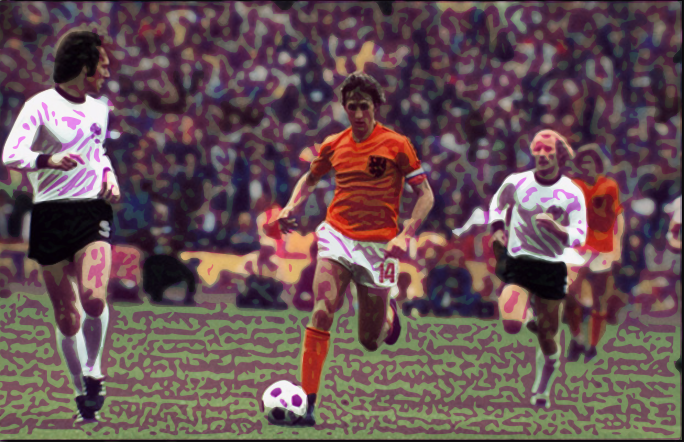
The 1974 World Cup was the stage upon which Total Football made its grand entrance to the global audience. Led by Rinus Michels and captained by Johan Cruyff, the Netherlands national team captivated the footballing world with their fluid, attacking football. The team featured versatile players like Johan Neeskens, Ruud Krol, and Wim Suurbier, all of whom were capable of playing in multiple positions and adapting to the demands of the system. This adaptability allowed the Dutch to dominate opponents with ease, as they moved the ball quickly, pressed high, and confused defenders with their positional interchanges.
Key Matches of the Tournament
The Dutch team’s campaign was filled with memorable moments that highlighted the power of Total Football. Their 4-0 demolition of Argentina in the group stage and a 2-0 victory over reigning champions Brazil in the semifinals were prime examples of how Michels’ system overwhelmed even the most experienced teams. In both matches, the Dutch played with an intensity and tactical fluidity that left their opponents chasing shadows, unable to cope with the speed and intelligence of their movement.
The Final Against West Germany: Triumph of the System but Not the Scoreline
Despite their dominance, the Netherlands fell short in the 1974 final, losing 2-1 to West Germany. Yet, the scoreline didn’t reflect the impact the Dutch had on the tournament. The final itself began with the perfect illustration of Total Football: the Netherlands kept the ball for the first minute without the Germans touching it, culminating in a penalty, which Cruyff won and Neeskens converted. Though the result was a bitter disappointment, the Dutch had won the admiration of fans and pundits alike, and Total Football had left an indelible mark on the game.
V. Evolution and Legacy of Total Football
Post-1974: The Spread of Total Football’s Ideals
In the years following the 1974 World Cup, the principles of Total Football spread across Europe and beyond. Clubs and national teams began to adopt elements of Michels’ philosophy, particularly the emphasis on high pressing and positional fluidity. Managers like Arrigo Sacchi in Italy and Johan Cruyff in Spain carried forward the ideals of Total Football, adapting them to suit their own environments. The philosophy also influenced individual players, with the likes of Xavi, Andrés Iniesta, and Lionel Messi embodying the spirit of fluid, intelligent play at Barcelona decades later.
Total Football’s Influence on Modern Tactics
The modern game owes much to Total Football. The high-pressing systems used by teams like Liverpool and Manchester City today are direct descendants of Michels’ ideas. Similarly, the focus on possession and positional play, seen in the styles of managers like Pep Guardiola, can be traced back to the principles Michels and Cruyff instilled at Ajax and Barcelona. Even as football continues to evolve, the core concepts of Total Football—teamwork, flexibility, and the ability to read the game—remain as relevant as ever.
VI. Criticism and Challenges
Tactical Limitations of Total Football
While Total Football was revolutionary, it wasn’t without its flaws. The system required immense physical fitness and tactical awareness, and not every team could replicate the success of Michels’ Ajax or the Dutch national team. Teams that were unable to maintain the relentless pressing or lacked players with the technical ability to switch positions seamlessly often struggled. Additionally, more defensively minded managers found ways to exploit the spaces left by Total Football’s fluidity, particularly with counter-attacking strategies.
Countering Total Football: The Rise of Pragmatism
In response to Total Football’s dominance, managers like Helenio Herrera, with his Catenaccio system, and later José Mourinho, with his defensive, counter-attacking setups, provided a pragmatic counterbalance. These managers focused on shutting down space, stifling the attacking fluidity of Total Football teams, and hitting them on the break. While these systems often lacked the aesthetic appeal of Total Football, they proved effective, highlighting the challenges that come with such an aggressive, attack-minded approach.
VII. Conclusion: A Legacy That Transcends Generations
The Enduring Impact of Total Football
Total Football’s legacy is undeniable. It changed the way football is played and thought about, inspiring generations of players, managers, and fans. Its influence can still be seen in the modern game, from the high-pressing styles of Klopp and Guardiola to the fluid positional play of teams across Europe. But more than just a tactical system, Total Football represented a new way of thinking about the game—one where creativity, intelligence, and collective effort took precedence over individualism.
The Future of Total Football’s Ideals
As football continues to evolve, the core principles of Total Football will undoubtedly remain part of its fabric. Future innovations may build upon Michels’ and Cruyff’s ideas, pushing the boundaries of what is possible on the pitch. But whatever the future holds, the influence of Total Football will continue to shape the beautiful game for generations to come.
