


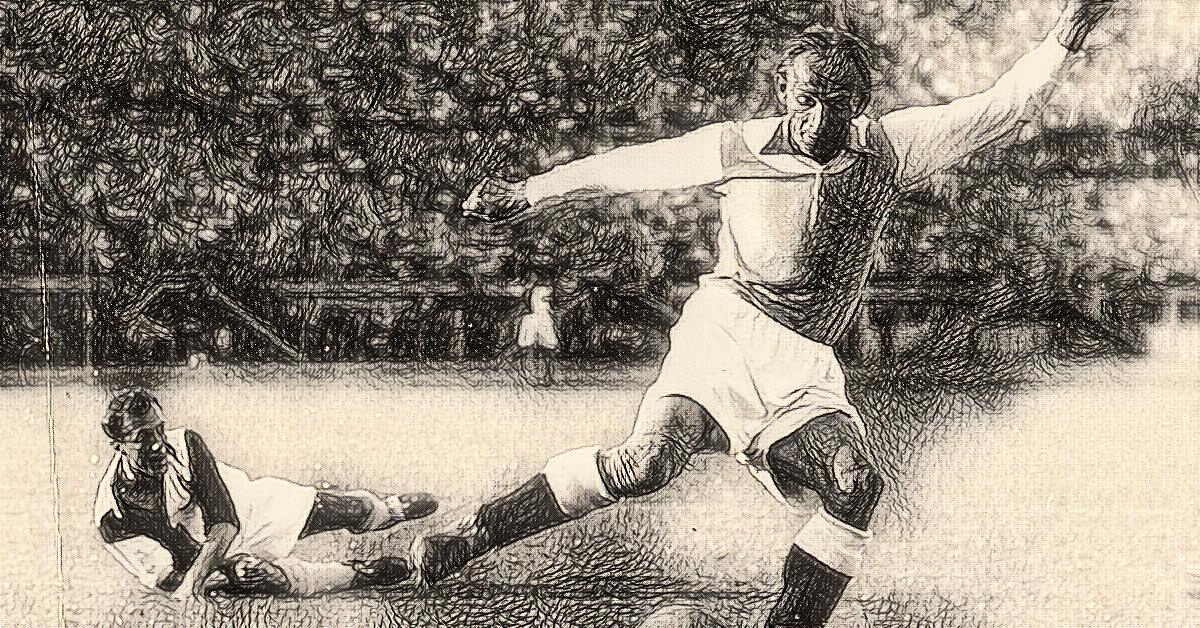
The history of football is often recorded in the cold, hard ink of statistics—goals scored, trophies won, and caps earned. Yet, every so often, a figure emerges who transcends the ledger, a man whose life and play were so inextricably entwined with the soul of a city that he becomes a ghost haunting its streets and its stadiums. Such a man was Matthias Sindelar, the “Mozart of Football,” a figure of fragile elegance who waltzed through the defence of empires and the darkness of the 20th century.
Matthias Sindelar and the Viennese Idea of Football
In the 1930s, before the tanks of the Third Reich rolled through its cobblestone boulevards, Vienna was a vibrant cultural hothouse, a city of music, psychoanalysis, and intellectual fervour. It was the city of Freud, Schnitzler, and Hayek, a place where the coffeehouses fizzed with passionate debate. In this atmosphere, football was not merely a physical contest; it was an intellectual pursuit, held in the same high esteem as a piano concerto or a philosophical polemic. And at the heart of this “Danubian School” of football was a slight, gaunt-looking man nicknamed “Der Papierene”—the Paper Man.
From Favoriten to the Streets of Vienna
The narrative of Matthias Sindelar begins not in the grand stadiums of Vienna but in the complex demographic shifts of the late Habsburg era. He was born Matěj Šindelář on February 10, 1903, in the Moravian village of Kozlov, in what is now the Czech Republic. His father, Jan, was a blacksmith, and his mother, Marie, was a housewife. Despite later myths frequently suggesting he was of Jewish origin—likely due to his lifelong affiliation with FK Austria Vienna, a club with deep roots in the Jewish bourgeoisie—the Sindelar family was Catholic.
In 1905, the family joined the great migration toward the imperial capital, settling in the rugged industrial hub of Favoriten. This was a predominantly working-class district, populated by “Brick Czechs” who spoke a slurred Viennese dialect. It was here, in the narrow streets, that young Matěj began playing football with balls made of rags. These street games were his conservatory; to survive the physical challenges of larger neighbourhood children—among whom was his future teammate Josef Bican—Sindelar had to develop extreme agility and evasion. He learned to use his slight build to his advantage, dodging and weaving with a grace that would one day be compared to ballet.
Tragedy struck early. In 1917, Jan Šindelář was killed on the Italian front during World War I, leaving Marie to support four children as a washerwoman. The teenage Matthias took up apprenticeships as an apprentice mechanic or a locksmith, selling sporting goods on the side to help the family make ends meet. Football, however, remained his true calling.
The Paper Man and the Knee That Changed Everything
In 1918, a scout spotted the fifteen-year-old Sindelar playing in the street and invited him to join the youth ranks of ASV Hertha Vienna. He quickly progressed to the first team, where his “ankle-breaking” agility and high-level technique allowed him to compensate for his frail, infantile physique. He earned his keep in the blue and white jersey of Hertha, but a serious knee injury in May 1923 nearly ended his story before it truly began.
In an era of primitive sports medicine, a meniscus tear was often a death sentence for a career. Sindelar, however, took the risk of meniscus surgery—a procedure then considered highly dangerous. He emerged from the recovery with his knee permanently bandaged, a physical vulnerability that many believe dictated his elusive, “Paper Man” style; he avoided physical contact at all costs to protect the joint.
Following an economic crisis at Hertha, he was signed by Wiener Amateur-SV in 1924, who would professionalise and change their name to FK Austria Vienna in 1926. It was here that his legend truly crystallised. Between 1924 and his death in 1939, Sindelar scored an astounding 240 goals in 312 league games for the club. In total, across all matches for Austria Vienna, he is reported to have scored 600 goals in 703 appearances.
Under the “Violet” banner of Austria Vienna, Sindelar became a master of his craft. He helped the team win the Austrian Cup five times (1925, 1926, 1933, 1935, and 1936) and the Mitropa Cup twice.
Coffeehouse Football and the Danubian School
To understand Sindelar, one must understand the Viennese coffeehouse culture. For the Viennese, the football pitch was an extension of the café—a place for creative intelligence and philosophical expression. While British football was a physical “kick and rush” affair, the “Danubian Whirl“ (or Viennese Whirlpool) was a victory of brains over brawn.
Coffee houses in Vienna were unlike anywhere else; they were reflective spaces that encouraged people to engage, often referred to as “extended living rooms”. Specific cafés were the headquarters of different clubs: fans of Austria Vienna frequented the Café Parsifal, while the central hub for the entire community was the Ring Café. Here, journalists, writers, and artists discussed tactical theories using coffee cups as positional markers.
Sindelar was the avatar of this intellectual movement. He famously pioneered the role of the “False Nine” (or second striker), dropping deep into the midfield to receive the ball and dragging opposing defenders out of position. This tactical revolution allowed him to act as a playmaker with “brains in his legs,” a description coined by the theatre critic Alfred Polgar. Polgar poetically remarked that “Sindelar’s shot hit the back of the net like the perfect punch-line, the ending that made it possible to understand and appreciate the perfect composition of the story”.
Hugo Meisl and the Birth of the Wunderteam
The story of the Austrian national team, the Wunderteam, is the story of a complex relationship between Sindelar and the manager, Hugo Meisl. Meisl was a disciplinarian who initially found Sindelar’s unpredictable style too individualistic and dropped him from the team for several years in the late 1920s.
However, the coffeehouse intellectuals would not be silenced. In 1931, Meisl was cornered by journalists at the Ring Café, who demanded Sindelar’s reinstatement. Meisl relented for a match against Scotland in May 1931. Reluctantly, he unleashed “The Mozart of Football,” and the Wunderteam was born in a 5-0 thrashing of a Scottish side that was then considered one of the masters of the game.
Between April 1931 and December 1932, the Wunderteam embarked on a 14-match unbeaten streak. They humiliated Germany 6-0 and 5-0, beat Switzerland 8-1, and hammered Hungary 8-2. In 1932, they won the Central European International Cup (Dr. Gerö Cup), the forerunner of the European Championship.
Their fame reached its zenith with a legendary match against England at Stamford Bridge in December 1932. Though Austria lost 4-3, they became only the third team from overseas to play in England, and their sophisticated passing style earned them a “moral victory” in the eyes of the British press. The Times noted that “English Team Lucky to Win,” marking the moment the world realised the Viennese Whirlpool was the future of the game.
Mitropa Cup Glory and the World Cup That Was Lost
The 1933 Mitropa Cup final was a quintessential Sindelar performance. Facing the Italian giants Ambrosiana Inter, led by the legendary Giuseppe Meazza, Austria Vienna lost the first leg 2-1 in Milan. In the return leg at the Prater Stadium, in front of 58,000 spectators, Sindelar scored all three goals—a hat-trick—to secure a 3-1 victory and a 4-3 aggregate triumph. He finished the tournament as the joint top scorer with five goals.
The height of their international fame coincided with the 1934 World Cup in Italy, a tournament repurposed by Benito Mussolini as a fascist propaganda vehicle. Austria was the clear favourite, but they fell in a controversial semi-final against the host nation. The Swedish referee, Ivan Eklind, was accused of extreme bias, reportedly having dinner with Mussolini before the match and even heading clear an Austrian cross during the game. Sindelar was brutally marked by Luis Monti, and on a muddy pitch in Milan, the Wunderteam was defeated 1-0.
The Anschluss and a Footballer’s Defiance
The world changed irrevocably on March 12, 1938, with the Anschluss—the Nazi annexation of Austria. The independent state of Austria was dissolved and renamed “Ostmark,” and the national football team was ordered to disband. Many of Sindelar’s Jewish friends and teammates were expelled or forced to flee as the professional league was dismantled.
The Nazi regime, eager to use the Wunderteam’s prestige for propaganda, arranged a “Reconciliation Match” (Anschlussspiel) between Germany and the former Austria on April 3, 1938. The script was pre-written: the match was intended to end in a cordial 0-0 draw to symbolise the “brotherhood” of the unified people.
Sindelar, the patriot, had other ideas. He insisted the Austrians play in their red-white-red colours—the colours of the national flag—instead of their traditional white and black. Throughout the first 70 minutes, he mocked the German team, weaving through their defence only to roll the ball agonisingly wide of the post or stop it on the goal line and turn back.
Then, in the 70th minute, he broke the script and scored. When his teammate Karl Sesta added a second to make it 2-0, Sindelar reportedly celebrated by dancing a mocking waltz in front of the Nazi dignitaries in the VIP box.
In the months that followed, Sindelar repeatedly refused to play for the newly unified German team for the 1938 World Cup, citing “old age” and “injury”. He chose instead to buy a café in Favoriten from a Jewish acquaintance, Leopold Drill, who was being forced to liquidate his property. Unlike others who took advantage of the “Aryanization” laws, Sindelar paid a fair price of 20,000 Marks for the business. He refused to display Nazi propaganda and continued to serve his Jewish friends, earning him the constant surveillance of the Gestapo, who marked him as “not sympathetic to the party”.
The Mystery of Sindelar’s Death
The story ends on the morning of January 23, 1939, in an apartment on Annagasse 3. A friend, Gustav Hartmann, forced his way into the flat after Sindelar had been missing for over 24 hours. He found Matthias Sindelar dead, lying beside his unconscious girlfriend, Camilla Castagnola, who would die shortly thereafter in the hospital.
The official verdict was carbon monoxide poisoning due to a defective chimney. However, the circumstances were immediately shrouded in myth. Three theories have persisted through the decades:
- Accident: Historical records show that neighbours had complained of faulty flues in the building only days earlier.
- Suicide: The writer Friedrich Torberg suggested in his poem “Auf den Tod eines Fußballspielers” (“On the Death of a Footballer”) that Sindelar took his own life as a protest against the “New Order”.
- Murder: Given his defiance, many believe the Gestapo silenced him. The police investigation was closed within two days, and records were allegedly destroyed or hidden.
Decades later, a lifelong friend, Egon Ulbrich, claimed that a local official had been bribed to record the death as an accident to ensure Sindelar could be given a state funeral—something forbidden for victims of murder or suicide under Nazi rules.
Why Matthias Sindelar Still Matters
Sindelar’s funeral was a final act of national identity. Over 20,000 people lined the streets of Vienna—an occasion described as the city’s “first and last rally against the Nazis”.
In 1999, Matthias Sindelar was voted Austria’s Best Footballer of the Twentieth Century and the world’s 22nd best player. He remains a tactical ancestor of the modern game, the first “False Nine” whose influence can be traced directly to icons like Lionel Messi.
Today, a street in Favoriten bears his name, and his grave in the Zentralfriedhof remains a site of pilgrimage. He was more than a player; he was the embodiment of a culture that refused to sell its soul. He was the Paper Man who, when the world grew heavy with iron and hate, remained as light and elusive as a waltz, dancing in the face of tyranny until the very end.
