


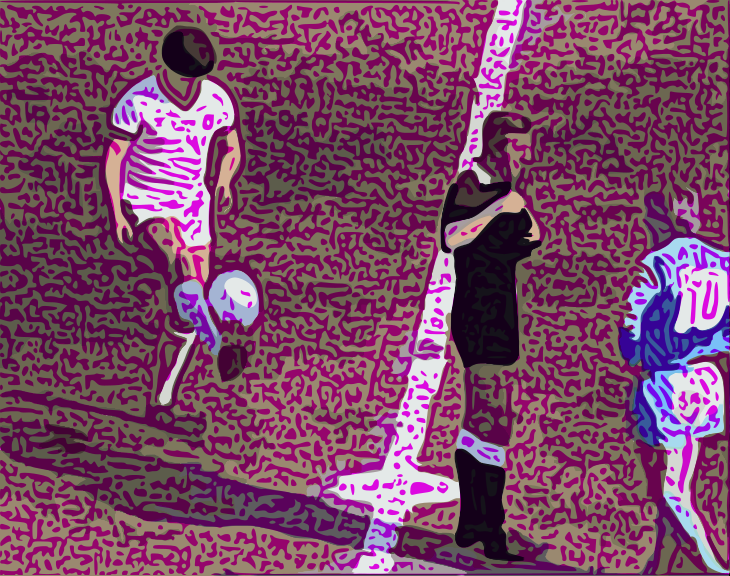
Many of you will be familiar with the incident in the 1978 World Cup when Brazil was preparing to take a corner at the end of their group match with Sweden. With the ball in the air referee Clive Thomas blew the final whistle to deny the Brazilians a late winner.
You may have believed this was the first time something like that had happened. But Thomas could’ve pinched the idea from Derek Civil, who did the same thing in an English First Division match in December 1977.
Thomas was infamous for a host of incidences, memories of which still hurt today, especially amongst Everton fans.
In Argentina in 1978 at the Estadio José Maria Minella, Mar del Plata, Brazil and Sweden were locked at 1-1 with the game nearing the 90th minute. Back in those days, there was no board to let everyone know how much time was being added on, it was simply at the discretion of the referee. Welshman Thomas, always one for the limelight, decided he needed to be the centre of the attention in a match so dire even the newly painted walls in the stadium were watching themselves.
Thomas gave Brazil a corner on the right. The linesman stopped them taking it quickly. When the ball was delivered Thomas blew the final whistle. Zico headed the ball into the net, for what he thought was a last-gasp winner only to turn round and see the officious Thomas marching self-importantly off to the dressing rooms. The Brazilian players surrounded him, unable to believe what he’d just done.
But ‘rules-are-rules’ Thomas was adamant anarchy would ensue if the laws were not adhered to, and the result stood at 1-1.
Those watching around the world could not believe what they were seeing. But Manchester City fans were able to give a knowing look to the telly having been on the receiving end of a similar decision just over six months before.
The game was an English First Division match at the Baseball Ground, home of Derby County on 3 December 1977.
Derby County
Derby, who’d been Champions in both 1972 and 1975, were on the slide a bit. When they lost at newly promoted, Bristol City, in November they were sitting just a point above the relegation zone. But wins against West Ham and away to Arsenal had given them a bit of a boost.
Derby’s side was much changed from their championship-winning team three seasons before. A month before they had lost Archie Gemmill to league leaders Nottingham Forest. Manager, Tommy Docherty, who himself had only come into the job in September 1977 brought in Billy Hughes, a member of the victorious Sunderland side which beat Leeds United in the FA Cup Final 1973.
In October Don Masson, who’d been part of a successful QPR team runners-up to Liverpool back in 1976, came into midfield in a deal which saw Leighton James go the other way.
Up front, they had the mercurial Charlie George, whose Arsenal career had been on the slide for a while. On either wing, he had Irishman, Gerry Ryan, signed from Bohemians and the unpredictable Terry Curran.
Curran was the type of winger many teams had back in the 70’s. Tricky, and difficult to read, no one really knew what he was going to do when he got the ball and players like him certainly added a few to the gate each time they turned out. He’d spent a couple of seasons under Clough at Forest when they were in the Second Division.
The Forest/Derby connection was also evident in the home side’s keeper, John Middleton. He was a regular in the Forest side which came up from the Second Division the season before. He played the first five matches of their first season back in the top flight, but mistakes in a 0-3 defeat at Arsenal convinced Clough he didn’t quite have the necessary qualities for a title bid. Clough bought Shilton and they won the league. Middleton moved to Derby.
At the back, they had the very experienced pairing of Colin Todd and Roy McFarland. The two had been influential during both league title successes. Of course, Clough had his fingerprints on this club too, as the man who led Derby to their first league title in 1972.
Derby’s start to the season had been disastrous. It took them eight games before registering their first win. Docherty had begun to settle things. But they’d gone through players at an alarming rate. By the time City arrived for this match, 26 had been used, which was in stark contrast to City’s 14.
Man City
City had finished second to Liverpool in the previous season, their best finish since they lifted the title eight years earlier.
A week before this match they thumped Chelsea, 6-2 and followed it up in by dumping Ipswich Town out of the League Cup in midweek.
Tueart hit a hat-trick against Chelsea, his second of the season. City were a fine attacking unit in those days. Only Everton (38) had scored more than their 32 at that stage of the season.
The attacking threat came from Mick Channon, 21 goals in 46 games for England, Brian Kidd, part of the Man Utd side which lifted the European Cup in 1968, Joe Royle and Dennis Tueart, both of whom had scored twice in six appearances for England. Royle was missing for this game, as he had for the previous five.
They also had winger Peter Barnes, who’d made his England debut just two weeks earlier.
The Match
Derby opened the scoring in the 34th minute when young Dublin-born right-back David Langan surged forward. He played the ball inside to George who waited for the Irishman to continue his run. A lovely through ball found him free in the area. Langan squared it for Hughes to hook it in with the heel of his right foot. It was his seventh of the season.
In the second half, George was again involved. He played the ball out wide to Ryan on the left. He twisted and turned as Kenny Clements back-peddled towards his own area. Once onto his right foot, he hit his shot straight at Corrigan, in the City goal. It bounced off the big keeper just passed Hughes, who then had his back to goal. Unable to control the ball, Hughes eventually gave way for Ryan who hooked his shot into the top corner and Derby were two goals to the good, with just over 20 minutes to go.
Hughes almost got his second after a ‘sparkling move’, as commentator Hugh Johns called it, between Ryan and Curran before Hughes headed the latter’s cross just over.
Tueart then went close as Middleton just turned it round his post after a dreadful backpass from George.
Then it all kicked off. It’s not certain what caused it, but the blue touch paper was definitely lit.
McFarland had the ball just inside City’s half on the left. All of a sudden, Hartford ran a full 20 yards just to ‘stick one on him’’. As players gathered round, George looked to have a bit of banter with Hartford. The Scot appeared unfazed by it, but Donachie decided to take exception by pushing George in the back. To which he received a typical retort from the ex-Arsenal striker.
This was where we first saw Civil. He booked Hartford but only after struggling to get his attention. The incident ended with a few words to the referee from Hartford.
The free-kick was played into the area by Masson for Rioch. He was shepherded out towards the corner flag. Presumably frustrated they couldn’t get the ball off him, Hartford then resorted to retrieving it but also bundling the Derby man over.
With the crowd incensed Hartford would probably be off these days. But Civil managed to calm things down with just a few words.
The free-kick was defended by City and Tueart booted it downfield away from danger. The experienced Todd was free to control the ball, but inexplicably it ran away from him. Suddenly Paul Power pounced. Todd only realised too late how much trouble he was in. Power, erm powered away and into the area as he moved inside to his left. With Kidd in space to his left, Power chose to use him as a decoy and hooked the ball inside the near post to give City a way back into the game.
Derby had been trying to run down the clock, and of course, no one had any idea how much time would be added on. City players were under the impression Civil would allow some time for this.
They had a free kick about 30 yards out. Hartford was about to take it with Civil stood just behind him. It appeared the ref wanted Hartford to move the ball back a bit. Without looking at him, Hartford bent down and threw the ball behind him and it hit Civil squarely in the face.
Nine years later in Monterrey, England’s Ray Wilkins was sent off for throwing the ball at the ref. But in this instance, Civil again chose the option of words rather than cards for the Scot.
But was he plotting his own retribution?
Hartford eventually took the kick but Derby defended it. Ryan knocked it out for a throw on the right wing. Power took it quickly, finding Channon down near the bye-line. He hooked it into the six-yard box where Tueart met it perfectly with his head and City equalised right in the dying moments.
Just as he was running round the ground Tueart had the agony of seeing the ref confirm the game was over before the ball hit the net.
The City players were incensed and surrounded the Birmingham-born official. Things were getting so heated Book ran onto the pitch to attempt to calm his players down. But Civil was unmoved and stuck by his decision.
City’s next home game, a week later, manager Tony Book included some opinions about the game. Fortunately for us, the website ‘citytillidie’ has preserved the programme notes. He certainly didn’t hold back.
“I try strongly to bite my tongue and avoid getting upset at refereeing decisions that I feel are unjust. But even as I write these notes, several days after 2-1 defeat at Derby, my anger has barely simmered from what it was last Saturday when Birmingham referee Derek Civil insisted that he had blown his whistle prior to Dennis Tueart’s header hitting the back of the Derby net for what most people in the ground, and, I’m certain, all the players on the field, thought was our last-ditch equaliser.
I thought we were cheated and robbed by the referee of a result from that game.
I am not arguing over the split-second when he blew the whistle because I am sure that Mr Civil was not mistaken. Where I considered we were cheated was in the fact that he played something in the region of 20 seconds of extra time despite all the time-wasting than had gone on in the second half as Derby naturally tried to hold on tightly to the lead they had acquired.
Even the most generous timekeeper will tell you that Mr Civil did not compensate for the time that he kept threatening to add on for the wastage. The City players and supporters received short-change on the deal which Mr Civil went to pains in the half to show they would get.
There was one remarkable example of what I mean shown on the televised version of the match last Sunday. The ball had gone into the Derby crowd behind the goal as we won our second corner in succession and there was no sign of it being returned by the fans. In full camera shot, Mr Civil could be seen with his arm in the air tapping his watch clearly signalling that he was going to add on time for the wasting, and whatever estimate you want to put on the incident, that ball was kept out of play by time-wasting fans for a minimum of 45 seconds. I calculated it at nearly 90 seconds.
That was only one of many incidents for which we were entitled to recompense that Mr Civil kidded us we were going to get. And yet the referee can happily admit after the match that he had played only 20 seconds extra. His judgement was diabolical.
My record will show that I have refrained from sniping at referees for most of my managerial term because I understand the difficulties of their job, and it is often possible to say things in the heat of the moment which are regretted later. But with Mr Civil, I must make an exception, and for many reasons.
I was not at all happy with his handling of the game, and that is not a one-sided opinion since the same view was expressed from the the Derby camp. He appeared to be frightened of making decisions. Ironically, the one he did make at the end was the most controversial of the lot.
On a personal note entirely I just hope that it’s a very long time before he gets an appointment to one of our matches. I would not feel very confident to think he was in charge.
I had to dash on the field at the end and try to subdue my players because they were incensed. It is not very often you see calm players like Tommy Booth and Dave Watson wanting to get involved in a heated situation, but they were so staggered at the end that they were in the midst of the shouting. And when players of that nature get so clearly upset then it is wise to move in before anything unfortunate takes place.
My players were appalled at what happened, so I can gauge the feelings of the City fans who made the trip to the Baseball Ground. My sympathies were with them as well as my own staff. What a way to lose!”
Tueart was on target again a week later when they beat Birmingham, 3-0. They lost their next away game, to Leeds, and then won eight in a row.
This took them into second place, six points behind Forest. But inexplicably they then failed to win any of their next nine and ended the season in fifth. But they did continue their goalscoring spree with only two clubs scoring more.
For Derby, it was a frustrating season. They only once registered back-to-back wins and finished losing as many games as they won, ending up in 12th.
Saturday 3 December 1977, 26,888
DERBY COUNTY (1) 2 (Hughes 34, Ryan 68)
MAN CITY (0) 1 (Power 83)
DERBY: Middleton; Langan, McFarland, Todd, Nish; Rioch, Masson; Curran, Hughes, George, Ryan
MAN CITY: Corrigan; Clements, Booth, Watson, Donachie; Hartford, Power; Tueart, Channon, Kidd, Barnes
The Referee
Civil, from Great Barr, became a referee in 1972 in a career which lasted 11 years. As with many referees in the 1970’s he had to deal with hooliganism. He was in charge of the infamous friendly between Aston Villa and Glasgow Rangers in October 1976 when he had to abandon the game after 53 minutes because of crowd trouble, labelled as ‘Sick Saturday’” and seen as ‘the worst trouble seen at Villa Park’.
Remember how Everton fans never forgot Thomas? Well, they had reason to remember Civil too. In his final season, he took charge of the Merseyside derby in November 1982. Everton were unbeaten at home yet faced an injury crisis in defence. Manager Howard Kendall signed Glen Keeley on loan from his old club Blackburn Rovers and immediately threw him in for the big game. With half-time approaching and losing 0-1, Keeley then pulled Dalglish’s shirt and Civil had little choice but to send the debutant off. Everton went on to lose 0-5.
Civil died in January 2009, aged 74.
