

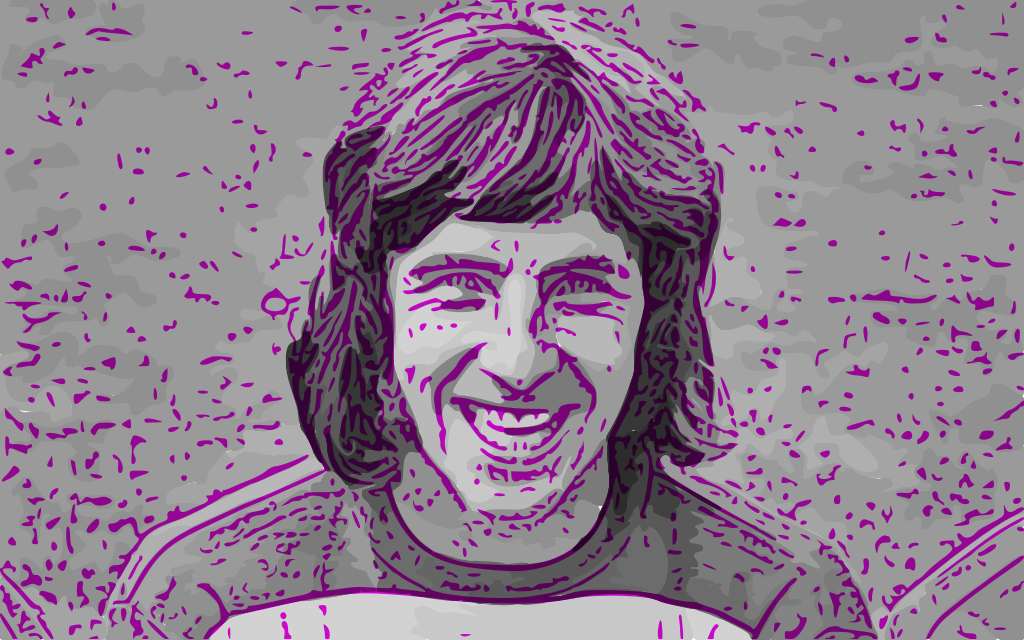
English football is mourning the death of one of its favourite players, Stan Bowles.
The news filtered through on Saturday night and started an avalanche of tributes from everywhere.
He was, simply, one of the most popular players the domestic game ever saw.
If you never had the pleasure of seeing Stan Bowles you could be forgiven for wondering what the fuss was about. He was only capped by his country five times, the only honour he ever won in a 16-year career was an appearance in the second leg of a European Super Cup match for Nottingham Forest against Barcelona.
Although perhaps it was fitting it came at the Nou Camp as Forest added a trophy to the European Cup they’d won eight months earlier. Bowles only stayed at the City Ground one season and could’ve won a European Cup too but for a falling out with Brian Clough.
Bowles was his own man. He would later admit he did things on instinct. Others may have regretted them, but Stan never did. It was just him.
The 1970s probably produced more of the Bowles-type than any other decade. Players who were ridiculously talented, without even trying, and sometimes they just couldn’t be bothered. With more money coming into the game, bringing more pressure on managers, his type were less tolerated as the decade wore on.
Yet they put bums on seats.
One QPR fan @mrsimmo1984 summed him up perfectly on X;
“If you’re old enough, he was your favourite player. If you missed his playing days, he is your Dad/Uncle’s favourite player.
A proper genuine one of R own, and the reason the number 10 means so much to all of us”
Football in the 70’s was a far simpler affair than today. Still within reach for the ‘man on the street’ the factories, warehouses and offices were full of people who just lived each week for Saturday afternoon.
You’d talk during the week about the game you were going to see on the Saturday. You were just hoping for one moment of magic to keep you going through the week. As you walked to the ground you’d discuss excitedly about what you might witness. Then when the game was over you’d stream out eagerly chatting about what you’d just seen.
If you’d seen a piece of genius from a player it would be the topic of conversation all week, until Saturday loomed into view and you wondered if you’d see something again.
If there wasn’t a moment of magic, then you’d spend the week eagerly anticipating it arriving the following weekend.
When their team wasn’t at home it was not uncommon for fans to turn up at a neutral ground just to see a game. QPR benefitted from this with their star attraction, Bowles.
Players were far more accessible to fans back then. We’d all been to school with players like Bowles, we’d had kickabouts in the street with them, everyone knew someone like him. We lived our dreams through them.
When he scored he had the manner of being the least surprised person in the ground. He was an entertainer. If he could beat a player more than once before scoring, he rarely passed up the opportunity. If it didn’t work he had that air of confidence it would work the next time.
For Stan he was prepared to risk the wrath of his manager, risk censure from the authorities if it went against his principles.
The reason he didn’t play in Forest’s 1980 European Cup Final was he’d told his manager where to stick it after Clough left him out of John Robertson’s testimonial. Robertson was his best friend at Forest and Bowles wanted to play. Clough had other ideas so Bowles walked away.
He said later he treated every match like a Sunday morning kickabout. It exasperated managers but the fans loved him for it.
He would turn up about 10 minutes before the game, put his kit on and away he went. His first manager at QPR, Dave Sexton told him;
“You can’t be doing this”
To which Stan replied;
“Listen Dave, to me it’s like a Sunday morning game, you get there late, you put your kit on and away we go.”
Sexton, a master tactician and ahead of his time in preparation and professionalism just said “I can’t talk to him.”
But the pair eventually found a way to get along.
Bowles told The Guardian in 2009;
“I didn’t like him at first, don’t get me wrong, but at the end I loved him to death. Dave would tell me specific things, ‘You do this, you do that’. I’d go ‘Yeah sure’. Soon as I went out there I made my own mind up, just make it up as I went along.”
He didn’t get along with Clough, but two egos rarely do. Of the modern managers Bowles says he’d have played for Mourinho;
“The secret to getting the best out of me? Don’t tell me what to do.”
His greatest moments came in the blue and white hoops at Loftus Road. Perhaps his peak was 1975-76 season when QPR came within 15 minutes of winning the league for, what remains the only time in their history.
Only Venables has managed to get them anywhere near close since when he steered them to fifth just before he flew off to Barcelona. You get the impression ‘El Tel´would’ve been good for Stan had he had the chance to manage him. Maybe his relationship with Gazza was Venables’ way of living that particular dream.
Bowles was born in Collyhurst, Manchester on Christmas Eve 1948. He began his career at Manchester City but it wasn’t long before he fell out with Malcolm Allison and Joe Mercer. He never liked either man. He idolised George Best and probably would’ve preferred the red half of Manchester. Not sure the two would’ve been great influences for each other, but boy they’d have given us some classic moments on the pitch, that’s for sure.
Bowles was then signed by Ernie Tagg at Crewe Alexandra in the Fourth Division. Tagg is often quoted with one of the most famous things said about the player;
“If he could pass a bookies as well as he passes a ball, he’d be a very rich man”
Bowles thought it was a bit rich for the manager to say that. He owned a pub and Bowles distinctly remembers him staying for a darts match rather than watch his team.
After a move to Carlisle United, he was sold for £110,000 to QPR in September 1972. He replaced another crowd favourite, Rodney Marsh, who moved to City.
At the end of his first season, they were up at Roker Park to take on FA Cup winners, Sunderland. The club had the trophy on show on a table at the side of the pitch. Bowles and his teammate, Tony Hazell, had a bet on who could hit it. Both men tried and both men succeeded.
The crowd went berserk. QPR won 3-0 with Bowles scoring twice but the game ended with a riot from the crowd.
“It was the headline on News at Ten.” said Bowles, “At least they had a riot in Sunderland. They don’t get many of them”.
Gordon Jago was replaced as boss at QPR by Dave Sexton in 1974. Bowles was the fulcrum of a captained by Gerry Francis and Sexton soon added the experience of John Hollins, Frank McLintock and David Webb.
According to Bowles, it took about 10 minutes for he and Francis to develop a ‘telepathic understanding on the pitch’.
They lead for a lot of the season having beaten Liverpool on the opening day at Loftus Road. 14 games unbeaten going into their final away game, they lost 2-3 at Norwich City.
A 2-0 win at home against Leeds United saw the team a point ahead at the top of the table. The players celebrated on the pitch. With Liverpool involved in the UEFA Cup Final, they had to wait 10 days before Liverpool played their final match of the season away at Wolves. With the home side needing to win to stay up they were a goal up going into the final 15 minutes. Kevin Keegan equalised for the visitors but they needed to win. Goals from Toshack and Ray Kennedy won it for Liverpool to give Bob Paisley his first league title.
QPR were heartbroken. It remains their best-ever league finish.
A year later Sexton moved to Manchester United and Tommy Docherty took over at Rangers. Typically Bowles was unimpressed.
“You can trust me, Stan”, the manager said. To which Stan replied
“I’d rather trust my chickens with Colonel Sanders.”
By then Bowles had come to the attention of England, predictably with mixed results. In Sir Alf Ramsey’s final game in charge of the national team, Bowles was one of six debutants in a friendly in Lisbon. Trevor Brooking and Dave Watson were two of the others.
After dispensing of Ramsey, England turned to one of Stan’s old bosses, Joe Mercer who took on a caretaker role. Bowles was in his first side for the trip to Wales in May. He scored his only goal in an England shirt in a game where Keegan also scored his first.
He kept his place in the side for the visit of Northern Ireland to Wembley four days later. 10 minutes into the second half with the game still goalless, Bowles was brought off by Mercer for Frank Worthington.
Bowles wasn’t impressed.
He left the hotel the next day despite Scotland coming up three days later.
“Mick Channon was my roommate and he said ‘You can’t do this to England.’
‘Watch me’, I said. ‘You see that car outside, that’s the one I’m jumping in’. I went to White City dogs that night.”
England didn’t come calling again for another 30 months until Don Revie surprisingly selected him for the crucial away World Cup qualifying tie in Italy. Struggling to get into the game in front of a three-man midfield containing two defensive players, he never had a shot on goal.
England lost and faced an uphill task to try and qualify for Argentina ’78. A task which eventually proved too much.
Bowles’ final outing in an England shirt came at Wembley in February 1977. The Dutch arrived with Cruyff, Neeskens and Krol and ran the show with a performance which had the home fans purring. Again he struggled to make an effect, often isolated on his own as Revie employed Keegan and Trevor Francis on either flank rather than in the centre.
Having fallen out with Docherty at Rangers he was consigned to six months in the reserves before he was sold to Forest. Unsurprisingly he was in a betting shop when he heard the news.
His heart wasn’t in it and the years of not bothering about his fitness were taking their toll too. He was desperate to move back to London and eventually, Leyton Orient came to his rescue.
A year later he moved to Brentford and by 1983 his career was over.
During his post-playing career, he spent a period as a pundit on Sky Sports as well as some after-dinner speaking engagements. In 2014 he was voted QPR’s greatest ever player.
In 2015 it was announced he was suffering from Alzheimer’s disease.
Stan Bowles died on 24 February at the age of 75.
There are all sorts of stories about Stan during his playing days, many of them at QPR. He was great mates with full-back Don Shanks as the two loved a bet. There is a story of QPR defending a corner and Stan and Don could hear some of the fans had radios on in the crowd. As the racing results were being announced both men realised they were about to hear whether they’d backed a winner so between them they made sure they kept knocking the ball out for more corners just so they could hear.
When he was called up by Revie for England, the boss was giving his typical non-motivational team talk and warned his players;
“And if any of you aren’t playing well enough you’ll be pulled off at half-time.”
“Blimey., said Stan to a player next to him, “At QPR they just give us an orange”
After announcing Stan’s death on X
“It is with a heavy heart we have learned that QPR legend Stan Bowles has passed away. A footballing icon and arguably the greatest to have ever worn our famous blue and white hoops. All our thoughts are with his family and friends at this sad time.
RIP Stan. Forever Rs”
It wasn’t long before the thread was inundated with messages of condolences with many saying he was their favourite player from a club they didn’t support.
He was one in a million, a man who just wanted to play the game his way. You cannot deny he was true to his principles. Whether he made the most of his talent is nobody else’s business but his. In an interview a few years ago he said he never regretted a thing about his career & felt he’d done everything.
There’s no denying he gave millions of people a lot of pleasure and for that we are truly thankful.
