

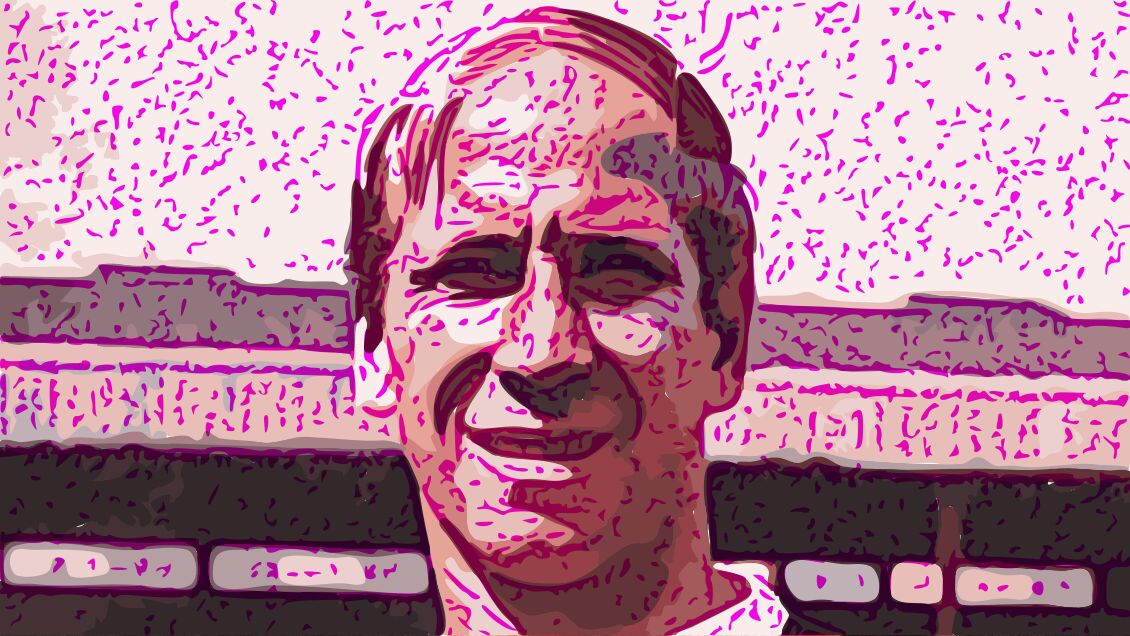
One of the saddest days in English football, as news of one of its greatest-ever players has passed away.
Bobby Charlton was a legend for both club and country. A world-class player, loved by virtually everyone. You never heard a bad word said about him.
In just over the past 12 months I’ve had to get used to a world without The Queen and now I have to get used to a world without Bobby Charlton.
As far as English football was concerned, he was royalty. It seems inconceivable to think of Manchester United without Bobby Charlton.
Involved in two of the finest club sides English football has ever known, and of course a crucial part of the English national side’s greatest team.
A central midfield player with a ferocious strike, he became the national team’s top scorer as early as 1963 and held the record until Wayne Rooney broke it in 2015.
He scored on his international debut in a 4-0 win over Scotland at Hampden Park in April 1958. Three weeks later he grabbed both in a 2-1 win when Portugal came to Wembley. Portugal would provide the opposition when Charlton had, probably his finest moment in an England shirt eight years later.
On a Tuesday night, under the lights at Wembley, Charlton scored twice to send England through to their only-ever World Cup Final. His second goal was a stunning strike. He had the ability to hit the ball and keep it down, not blast it wildly. He purred across the ground, meeting the ball perfectly with his instep. The trajectory of the ball rising gradually and appeared to pick up speed through the air.
His first goal came when the keeper came out to block Roger Hunt’s attempt. The ball ran clear to the edge of the area and Charlton just sauntered up and calmly placed it past two defenders into the net. His second goal was a classic example of a team where all the players knew their roles. Cohen played the ball up ahead of the defence. Hurst held off the challenge in the area and knew he had two choices. Either cross to Hunt in the middle or lay it back for where he knew Charlton would be arriving. He chose the second option and right on cue Charlton popped up and thundered it into the net.
For Charlton, the Final was a bit of a disappointment. He would say later both he and Beckenbauer cancelled each other out during the match neither was really able to enjoy it.
England beat West Germany and as he celebrated with his brother Jack on the pitch, he uttered an immortal phrase;
“Our lives will never be the same”, and how right he was.
He scored three during that tournament and his first was probably the best. After a dull goalless draw in their opening game against Uruguay, the country’s mood had lowered. Maybe these players weren’t as good as they’d believed? Maybe this wasn’t their time?
In the next game against Mexico with half-time looming and the game still without a goal, Charlton picked the ball up in space in the centre circle just inside his own half. Surging towards the Mexican goal, with the defence backtracking, he had Hunt to his right and Hurst to his left. He looked to go to his left, then dropped his shoulder to move to his right. From about 30 yards out he decided to go it alone and unleashed an unstoppable shot which went like an arrow into the top corner.
It was exactly what the team, the fans and the country needed and they were off and running.
I remember an interview with him on Football Focus one Saturday, possibly at the end of the 70s. He explained how he learned to kick a ball with both feet and the secret to his ability to hit a ball from long range.
He described some garages near to his house where they used to play football. As a young lad, he drew a line on the wall about a couple of feet off the ground. He would then hit the ball against this line, with either foot. Then gradually he would move further back and continue this routine.
Eventually, he was hitting the ball from about 20-30 yards, with either foot and that’s how he learned to keep the ball down. It explains how his shots would go like an arrow rather than get blasted over the bar.
He could never really understand why professional players hadn’t practiced enough to learn to kick with either foot. Geoff Hurst once said of him you could never really tell whether he was left or right footed.
Robert Charlton was born on 11 October 1937 in Ashington, Northumberland. Jack was two years his senior. The Charlton’s were from footballing stock. Legendary Newcastle and England striker, Jackie Milburn was their mother’s cousin. They were also related to Jack Milburn (Leeds United and Bradford City), George Milburn (Leeds United and Chesterfield), Jim Milburn (Leeds United and Bradford Park Avenue) and Stan Milburn (Leicester City and Rochdale).
While playing for East Northumberland schools he was spotted by Manchester United chief scout, Joe Armstrong. Armstrong was also responsible for spotting Duncan Edwards. Both players became part of the Busby Babes, a group of exciting young players United manager, Matt Busby had put together in the 1950’s.
Charlton made his debut for United against Charlton Athletic in October 1956. He scored twice and then hit a hat-trick in the return fixture the following February. United won the league that year and were beaten in the FA Cup Final, denying them what would have been the first “double” of the 20th century.
As champions they entered the European Cup the following season, becoming the first English club to do so. They made it all the way to the Semi-Finals where they lost to a Real Madrid side containing Alfredo di Stefano and Raymond Kopa. Real went onto lift the trophy that season, their second in a run of five successive triumphs.
They retained their league title during the European Cup run so in 1957-58 they were back in the competition. At the Quarter-Final stage, they were drawn against Yugoslav champions Red Star Belgrade. They won the first leg 2-1, with Charlton on target and were 3-0 up in Belgrade as Charlton scored another two. The home side came back to level 3-3 but United were through to their second successive European Cup Semi-Final.
Due to play Milan in the Semis, the team boarded the plane in Belgrade for the journey back to Manchester. They needed to stop in Munich to refuel but the weather had worsened and snow lay on the runway. After two aborted attempts to take off, the plane tried a third time. It crashed at the end of the runway, clipping a fence and hitting a house. The plane was cut in half.
Charlton, who had swapped places with Tommy Taylor, was thrown out of the cabin still strapped to his seat. Goalkeeper, Harry Gregg found him and thought he was dead but dragged him away from the plane. Gregg was heroic that night, pulling several people from the wreckage as he feared the plane could explode.
Eventually Charlton revived himself and climbed out of his seat. He suffered cuts to his head and naturally was in severe shock leading to a stay in hospital for a week. Seven of his teammates died on the runway, including Taylor. Edwards later died of his injuries and in total 23 people died as a result of the crash. Of the eight players who survived, two of them were so badly injured they never played football again.
The whole country was in shock. Charlton returned home to convalesce. With the majority of the team cruelly taken far too early, the club was in turmoil. Many clubs offered players to help them put out a team and fulfil their fixtures. Remarkably, they reached the FA Cup Final again, this time losing to Nat Lofthouse’s Bolton Wanderers.
Charlton had to wait until 1963 before he won an FA Cup winners’ medal when they won 3-1 against a Leicester City team containing Gordon Banks and Frank McLintock. By now Busby was building his second great team at Old Trafford as Denis Law, David Herd, Paddy Crerand and Tony Dunne were now influential.
Two years later Charlton had his third league championship medal as another legend George Best now emerged at the club. The following year they were back in the European Cup for the first time since the Munich disaster.
In the Quarter-Finals they were up against Eusebio’s Benfica. Taking a 3-2 lead to the Estådio da Luz where they put on one of their greatest ever performances. Best scored twice in the opening 15 minutes as they were 3-0 up at the break. The young Irishman was incredible that night as United won 5-1 with Charlton getting the fifth.
The Semi-Final saw them return to Belgrade, this time to take on Partizan. They lost the first leg in Belgrade, 0-2. They could only win the second leg 1-0 and were again denied a place in the Final.
They won the league again in 1966-67 and so were back into the European Cup for the 1967-68 season. They reached another Semi-Final and again paired with Real Madrid. A George Best goal at Old Trafford gave them a narrow advantage to take to the Bernabeu. 1-3 down at the break they were heading out but goals from David Sadler and Bill Foulkes, who was a survivor of the Munich air crash, earned them a famous draw and they were finally into the Final.
29 May 1968 was an emotional occasion. Busby had finally seen the culmination of his rebuilding project at Old Trafford bear fruit as his second great side had at last reached the pinnacle of European club football. The game was at Wembley and they were up against Benfica again.
Charlton gave United the lead early in the second half. They held it until 11 minutes from time when Graca equalised, taking the game into extra time. United scored three times in the first nine minutes of extra time with Charlton grabbing his second.
He was captain that night and had the honour of lifting the trophy. Rarely given to revealing his emotions, one can only imagine his mind drifting to the eight teammates he lost at Munich.
He said privately he thought about the friends and teammates he’d lost “every single day” of this life. He never revealed whether he had survivor’s guilt, but it would seem pretty amazing if he didn’t.
He had become one of the greatest players in the world. He’d won the league, the FA Cup, the World Cup and the European Cup. He’d done it all, when those eight lads who perished on that runway were expected to do just that.
The game came a week after he’d been on target at the same venue in an England shirt as they beat Sweden in a friendly. It was his 21st goal at Wembley for his country, and his 45th in total.
He captained his country on three occasions, all of them at Wembley. The first came in January 1969 when Romania came to Wembley for a friendly. As world champions, England had the honour of not having to qualify for the next tournament so this was valuable preparation. His brother Jack put England ahead only to see the visitors grab a draw.
The other two instances were in the final few months before the Mexico World Cup. A Dutch side, including Johan Cruyff and Ruud Krol, held England to a goalless draw and then in April Charlton finally lead his side to victory.
April 1970 was a special occasion. It was his 100th appearance for England. Bobby Moore was in the side but Ramsey gave Charlton the honour of leading the side out. Northern Ireland were the visitors and England ran out comfortable 3-1 winners, with Charlton getting the third. The scoresheet read like a who’s-who of legends from 60’s and 70’s football. Peters, Hurst and Charlton for England, George Best for the Irish.
It was England’s final home game before the World Cup. They then embarked on a trip to South America in preparation. They visited Colombia where Charlton scored his 49th goal for England in a 4-0 win. It would prove to be his last goal for his country, but the trip was remembered more for an incident off the pitch.
During their stay they were warned not to go out alone, so Charlton and Moore wandered around the shops on the ground floor of the hotel. They looked in a jewellers and Charlton asked to see a bracelet he was thinking of buying for his wife. Once he found out it cost more than his house he handed it back and they left. They were sat in some seats just down from the shop when the assistant came running out and accused Moore of stealing the bracelet.
You could not meet two people less likely to steal anything than Charlton and Moore. But the police were called and Moore was arrested. He was released in time for the team to fly to Quito to play some friendlies, but when they returned to Bogota Moore was re-arrested.
It was touch and go whether the England captain would be able to travel with the team to Mexico. It became an international incident. The case got as far as court but Moore was released again through lack of any credible evidence.
Charlton would’ve taken Moore’s place had the captain been held in Colombia any longer. Eventually Moore joined up with the squad, already in Mexico, with the World Cup just days away.
The 1970 tournament was a frustrating one for England, the defending world champions. They struggled with the heat and Ramsey took precautions with Charlton in particular. He substituted him in three of their four matches.
The most famous example was against West Germany in the Quarter-Finals. Once again Charlton and Beckenbauer cancelled each other out as England cruised into a two-goal lead. Ramsey swapped Charlton with Colin Bell and Beckenbauer now had more space to cause problems. He scored the German’s first goal and they went onto win 3-2 after extra time.
On the plane back home Charlton decided to call time on his international career and asked Ramsey not to consider him again.
106 caps and 49 goals were records for England at the time. Bobby Moore eventually went passed the appearance record in 1973 and it wasn’t until 2015 when Wayne Rooney surpassed his goalscoring record.
Once back at club level, United were regressing at an alarming rate, flirting with relegation. Charlton left at the end of the 1972-73 season. A year later they were relegated.
Charlton’s record at Old Trafford was 758 appearances and 249 goals. Ryan Giggs eventually went past his appearance record in 2008 with Rooney only just beating his goal scoring record.
After his playing career ended Charlton turned his hand to management with little success. He took over at Preston North End but they were relegated in his first season. He left two years later after a disagreement. He had a brief spell as caretaker manager at Wigan in the early 80’s but that didn’t result in a full-time appointment.
His main role since then has been as a director at Manchester United and acted as an ambassador at the club. Many players over the years have spoken of the times he would come into the dressing room to chat to them, regardless of whether they’d won or lost. He was free with his advice.
In addition to his winners’ medals of three league championships, a World Cup a European Cup and an FA Cup, he was voted Footballer of the Year in 1966, won the Ballon d’Or and World Cup Golden Ball in the same year. He was runner-up in the Ballon d’Or over the next two seasons too. He received an OBE in 1969, a CBE in 1974 and knighted in 2012.
He can quite easily be considered one of the greatest players England has ever produced.
Charlton met Norma Ball in 1959 and the pair married in 1961. They had two daughters, Suzanne and Andrea. Bobby was a proud grandparent too.
He achieved so much in the game, won everything it was possible for a player to win. Yet he always remained humble and rarely courted publicity or the limelight. He was fiercely proud of the club he served his whole life and always honoured to be selected to play for his country.
Football has lost a true great of the game.
